top of page
My Inspiration!
A compilation of the people, ideas, and communities that have helped shape this project and supported me every step of the way
Games
Darkwood

A top-down horror game, where you can only see environmental threats if you shine your flashlight towards them. Otherwise, you'll be forced to listen close to sounds in the environment to keep track of what creatures are around, and whether or not you're safe.
I'm a huge fan of the Darkwood's sound design and use of light, and the game serves as the #1 source of inspiration for how I implemented directional sound cues and light levels in First Encounters!
FNAF 1's introductory "Phone Guy" audio really inspired the type of tone I wanted to use for my own intro cutscene, and the game's generally quiet audio cues for enemy movement helped me shape my own enemies' volume.
I also have to give credit to the fourth entry in the FNAF series. Similar to Darkwood, FNAF 4 relies a lot on listening very closely to audio, and I definitely tried to borrow some of that some energy for First Encounters.
Five Nights at Freddy's

Chants of Sennaar

Chants of Sennaar tasks the player with exploring a new civilization and deciphering puzzles, all of which are written in a completely different language. It's a puzzle game that bases its mechanics on careful observation and using context clues to learn how to translate and communicate with the world around you.
Although Chants of Sennaar is far from a horror game, I was really captivated by the idea of taking information that seems indecipherable at first, and learning to understand what different sounds/visuals mean. Since group communication is one of the defining features of the Click Deer (over 60+ different clicking patterns!), I thought it would be a fun mechanic to borrow from Chants of Sennaar and the deer different patterns of clicks that the player can learn to decipher the meanings of by listening closely.
Concepts
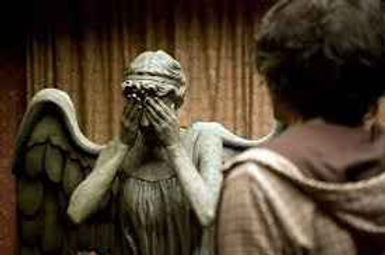
The "it only moves when you look away" genre of enemies is nothing new to horror, and we have Doctor Who's Weeping Angel entities to thank for popularizing that.
The idea of bringing that idea to the Click Deer came pretty early in development, stemming from real-world deer's tendency to freeze in car headlights or when they notice they're being watched. Since the Click Deer are hunting animals, I decided to reflect that behavior through "Weeping Angel" behavior during hunts.
Weeping Angels
Dynamo Flashlight

Amnesia manages to use the most standard of player's tools to amplify horror, and the game's flashlight system is no different. In Amnesia, players are equipped with a dynamo flashlight, whose light lasts far shorter than any standard flashlight. Fortunately, players can yank a connected cord to recharge it. Unfortunately, doing so is quite loud and time-consuming; and who knows what you'll attract making all that noise?
I'm definitely wearing my inspiration on my sleeve with this one. I had already envisioned light and sound as integral parts of Click Deer's behavior--having a similar flashlight system to Amnesia where players have to make noise to keep their light just seemed like too good an opportunity to miss.
Jumpscares
I've got a bit of a love-hate relationship with jumpscares, particularly in indie horror games. I've heard a game dev scaring someone was a cheap jumpscare is like a comedian tickling someone to make them laugh. Sure, you got the laugh, but nothing was really funny...
While I think jumpscares can add a lot to a game if they're well-earned and used sparingly, I also always wanted to challenge myself by making a horror experience without relying on any jumpscares. That sentiment is partially what drew me to the "psychological horror" genre for First Encounter, and why so much of the game relies on quiet audio.

Special People
My Family!
Wonderful supporters of my project and (mostly willing) test subjects whenever I needed to verify how effective my game's horror was. Neither the concept of Click Deer nor the game itself could have ever existed, if I didn't have the endless love and support of my mother, father, and sister.
Julie Babcock
My amazing WRITING 220 and WRITING 420 instructor, and the person who pushed me to pursue the crazy idea of a making a game for a writing class project in the first place. Over the past year, Julie's given me all the support, encouragement, feedback, and resources I could ask for.
David Ward
My WRITING 420 consultant, who gave me constant support and feedback as I developed my project. Whenever I needed someone to bounce ideas off of or think about my project with, David was there to listen, offer his own thoughts, and get me connected to other resources for my project. Not to mention the playtesting David offered, helping me figure out where my game needed polishing before I fully presented it. This game and all the concepts within it would look much rougher without David’s support!
Nature Has Eyes Team
My environmental horror teammates, and the group that helped me figure out all the different details that went into my game design. I have to thank them for also putting up with all my rambling whenever I was bouncing ideas off them for my game. So much of the game’s polish and design choices are thanks to them and the conversations we had together.
Writing Capstone Classmates
Last but not least, all my classmates from my Writing Capstone Course. Thank you for all the feedback you’ve given me for my project, and all the fun conversations we’ve had outside of it. Being able to share my project with them was one of the highlights of this semester, and has helped me motivate me through the most annoying of game dev sessions. To each and every one of my classmates, I wish them all the best of luck for all that they continue to make!
To all of you have given me all the inspiration and support I needed and more, there is not a single part of this project that could exist without your collective help. So to everyone here, thank you! =)
bottom of page